


| Criteria | Weightage |
| Appreciation Potential | 30% |
| Rental Demand | 20% |
| Infrastructure Growth | 20% |
| Economic Activity | 15% |
| Liquidity | 10% |
| Risk Profile | 5% |
This guide is designed for:
Investors seeking wealth preservation and long-term appreciation.
Individuals looking to build India-based assets while benefiting from currency diversification.
Entrepreneurs seeking to diversify profits into tangible investments.
Those planning to expand beyond equities and fixed-income products.
Investors focused on multi-generational wealth creation.
The best places to invest in India for high returns are not necessarily the cheapest markets.
The strongest opportunities typically emerge where infrastructure growth, employment expansion, premium demand, and limited quality supply intersect.
The cities covered in this guide have been selected based on these principles to help investors deploy capital more strategically and reduce avoidable investment mistakes.
Gurgaon has evolved from a satellite city into one of India’s most valuable real estate markets. Today, it attracts HNIs, NRIs, CXOs, entrepreneurs, and institutional investors looking for a combination of capital appreciation, rental income, and wealth preservation.
Unlike many cities where growth is dependent on a single factor, Gurgaon benefits from multiple demand drivers including corporate expansion, world-class infrastructure, airport accessibility, and a mature luxury housing ecosystem.
For investors seeking high returns, Gurgaon remains one of India’s strongest opportunities in 2026.

Gurgaon houses offices of hundreds of multinational corporations across sectors such as:
Technology
Consulting
Banking
E-commerce
Startups
Manufacturing
Major employment hubs include:
Cyber City
Udyog Vihar
Golf Course Road
Sohna Road
Sector 74A Business District
Gurgaon continues benefiting from large-scale infrastructure upgrades.
Key developments include:
Dwarka Expressway (Operational)
Southern Peripheral Road (SPR)
Delhi Metro Connectivity
NH-48 Access
Proximity to IGI Airport
Premium housing demand remains robust due to:
Rising HNI population
NRI investments
Executive housing requirements
Wealth diversification
Compared to smaller cities, Gurgaon offers stronger resale demand and a larger buyer pool.
This reduces exit risk for investors.
| Parameter | Details |
|---|---|
| Investment Rating | 9.5/10 |
| Market Type | Premium & Luxury |
| Capital Appreciation Potential | Very High |
| Rental Yield Potential | Moderate to High |
| Liquidity | Excellent |
| NRI Appeal | Excellent |
| End User Demand | Strong |
| Corporate Demand | Very Strong |
| Risk Level | Moderate |
| Location | Average Price/Sq.Ft. | Investment Potential |
|---|---|---|
| Golf Course Road | ₹22,000–₹40,000+ | High |
| Golf Course Extension Road | ₹16,000–₹28,000 | Very High |
| Dwarka Expressway | ₹14,000–₹25,000 | Very High |
| SPR Corridor | ₹13,000–₹22,000 | High |
| New Gurgaon | ₹10,000–₹18,000 | Moderate to High |
| Sohna Road | ₹11,000–₹17,000 | Moderate |
Dwarka Expressway has emerged as Gurgaon’s fastest-growing investment corridor.
Direct Delhi connectivity
Airport accessibility
Infrastructure upgrades
New luxury launches
Growing commercial ecosystem
Long-term investors
NRIs
Capital appreciation seekers
| Sector | Popular Projects |
|---|---|
| 103 | Godrej The Vrikshya |
| 106 | Elan The Presidential |
| 109 | Upcoming Luxury Launches |
| 113 | Smartworld One DXP |
One of Gurgaon’s most established premium corridors.
Strong rental demand
Mature infrastructure
Premium lifestyle ecosystem
Corporate accessibility
End users
Rental investors
Luxury buyers
| Sector | Popular Projects |
|---|---|
| 49 | Godrej Aristocrat |
| 63A | Premium Launches |
| 65 | M3M Altitude |
| 67 | Luxury Projects |
SPR continues attracting premium residential developments.
Strategic connectivity
Lower entry prices
Growing social infrastructure
Future appreciation potential
Growth investors
Family buyers
HNIs seeking value
| Sector | Popular Projects |
|---|---|
| 70 | Tulip Crimson |
| 71 | Signature Global Titanium SPR |
| 76-77 | DLF Privana Projects |
Rental income remains an important component of total returns.
| Location | Approx. Rental Yield |
|---|---|
| Golf Course Road | 2.5%–3.5% |
| Golf Course Extension Road | 2.5%–4.0% |
| Dwarka Expressway | 2.0%–3.0% |
| SPR Corridor | 2.0%–3.2% |
| New Gurgaon | 2.0%–2.8% |
| Corridor | Appreciation Potential |
|---|---|
| Dwarka Expressway | Very High |
| SPR | High |
| Golf Course Extension | High |
| New Gurgaon | Moderate to High |
| Sohna Road | Moderate |
| Project | Builder | Location | Starting Price | Best For |
|---|---|---|---|---|
| DLF Privana West | DLF | Sector 76-77 | ₹6.5 Cr+ | HNIs |
| Godrej Aristocrat | Godrej | Sector 49 | ₹5.5 Cr+ | Luxury End Users |
| Krisumi Waterfall | Krisumi | Sector 36A | ₹4 Cr+ | NRIs |
| Godrej The Vrikshya | Godrej | Sector 103 | ₹3.8 Cr+ | Appreciation Investors |
| Tulip Crimson | Tulip | Sector 70 | ₹4.5 Cr+ | Family Buyers |
| DLF Privana North | DLF | Sector 76-77 | ₹7 Cr+ | Ultra HNIs |
| Elan Presidential | Elan | Sector 106 | ₹4.5 Cr+ | Airport Investors |
| Smartworld One DXP | Smartworld | Sector 113 | ₹3.5 Cr+ | Premium Buyers |
Gurgaon offers wealth preservation, strong appreciation, and luxury inventory.
Golf Course Extension Road
DLF Townships
SPR
Airport connectivity and established developer ecosystems make Gurgaon attractive.
Dwarka Expressway
DLF Developments
Krisumi Projects
Focus on mature premium corridors.
Golf Course Road
Golf Course Extension Road
Target emerging growth corridors.
Dwarka Expressway
SPR
Despite strong fundamentals, investors should remain aware of potential risks.
Overpaying during peak cycles
Selecting weaker developers
Excess supply in certain pockets
Ignoring exit liquidity
Investing without due diligence
Yes. Gurgaon remains one of the best places to invest in India for high returns due to its strong corporate ecosystem, premium housing demand, infrastructure growth, airport connectivity, and consistent interest from HNIs and NRIs.
Dwarka Expressway currently offers some of the strongest appreciation potential in Gurgaon due to ongoing infrastructure upgrades, improving connectivity, and increasing residential demand.
For investors seeking a balance between appreciation, rental income, and long-term wealth preservation, Gurgaon stands among India’s strongest real estate markets.
Whether the objective is capital growth through Dwarka Expressway, rental income from Golf Course Extension Road, or premium family living along SPR, Gurgaon provides opportunities across multiple investor profiles.
Best For:
✓ HNIs
✓ NRIs
✓ Business Owners
✓ Long-Term Investors
✓ Luxury Homebuyers
Over the last decade, Hyderabad has transformed from an emerging IT city into one of India’s most attractive investment destinations. Compared to other metros, Hyderabad offers a rare combination of relatively affordable entry prices, robust infrastructure, strong employment growth, and improving rental yields.
For investors seeking high returns with comparatively lower acquisition costs than Mumbai or Gurgaon, Hyderabad deserves serious consideration.
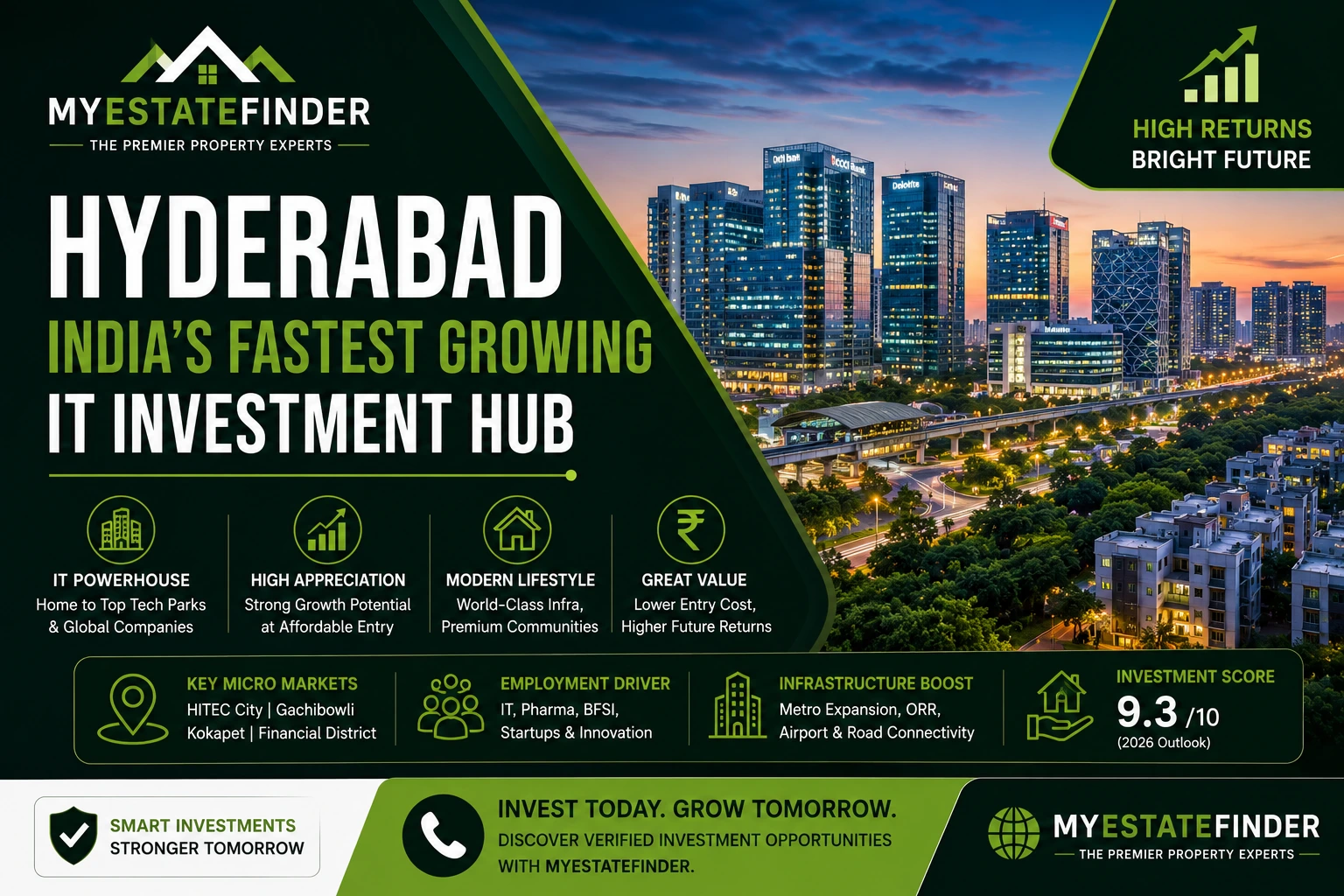
Hyderabad has become a major technology and business hub.
Global companies with large campuses include:
Microsoft
Amazon
Apple
Deloitte
Accenture
Facebook (Meta)
This employment ecosystem supports long-term housing demand.
Compared to other major cities, Hyderabad still offers relatively attractive pricing in premium locations.
This provides investors with higher upside potential.
Major infrastructure projects continue reshaping the city.
Key developments include:
Outer Ring Road (ORR)
Hyderabad Metro Expansion
Regional Ring Road
Airport Connectivity Enhancements
IT Corridor Expansion
| Parameter | Details |
|---|---|
| Investment Rating | 9.3/10 |
| Market Type | Growth Market |
| Appreciation Potential | Very High |
| Rental Yield Potential | Moderate to High |
| Liquidity | Very Good |
| NRI Appeal | Strong |
| Corporate Demand | Excellent |
| Risk Level | Moderate |
| Location | Average Price/Sq.Ft. | Investment Potential |
|---|---|---|
| Gachibowli | ₹10,000–₹16,000 | Very High |
| Financial District | ₹11,000–₹18,000 | Very High |
| Kokapet | ₹9,500–₹15,000 | High |
| Narsingi | ₹8,500–₹13,500 | High |
| HITEC City | ₹11,000–₹18,000 | High |
| Kondapur | ₹8,000–₹12,000 | Moderate to High |
Major IT hub
Premium developments
High executive demand
Strong rental market
Rental investors
IT professionals
HNIs
Emerging luxury corridor
Lower entry prices
Infrastructure upgrades
Future growth potential
Long-term investors
Capital appreciation seekers
Established market
Excellent connectivity
Stable rental demand
End users
Rental income investors
| Location | Approx. Rental Yield |
|---|---|
| Gachibowli | 3.0%–4.0% |
| Financial District | 3.0%–4.2% |
| HITEC City | 3.2%–4.5% |
| Kokapet | 2.8%–3.5% |
| Kondapur | 2.8%–3.6% |
| Corridor | Appreciation Potential |
|---|---|
| Financial District | Very High |
| Kokapet | Very High |
| Gachibowli | High |
| HITEC City | High |
| Narsingi | High |
Strong appreciation opportunities with lower acquisition costs.
Fast-growing IT ecosystem with increasing global appeal.
Healthy rental yields supported by IT employment.
Significant growth runway remains.
Yes. Hyderabad is one of India’s best cities for property investment due to strong IT growth, improving infrastructure, competitive pricing, and increasing rental demand.
Hyderabad offers one of the best risk-reward profiles in Indian real estate today.
Best For:
✓ Growth Investors
✓ NRIs
✓ IT Professionals
✓ Rental Investors
✓ Long-Term Wealth Creators
Bengaluru remains one of India’s strongest real estate markets due to its diversified employment base, startup ecosystem, and exceptional rental demand.
For investors prioritising steady cash flow and long-term appreciation, Bengaluru continues to be a top choice.
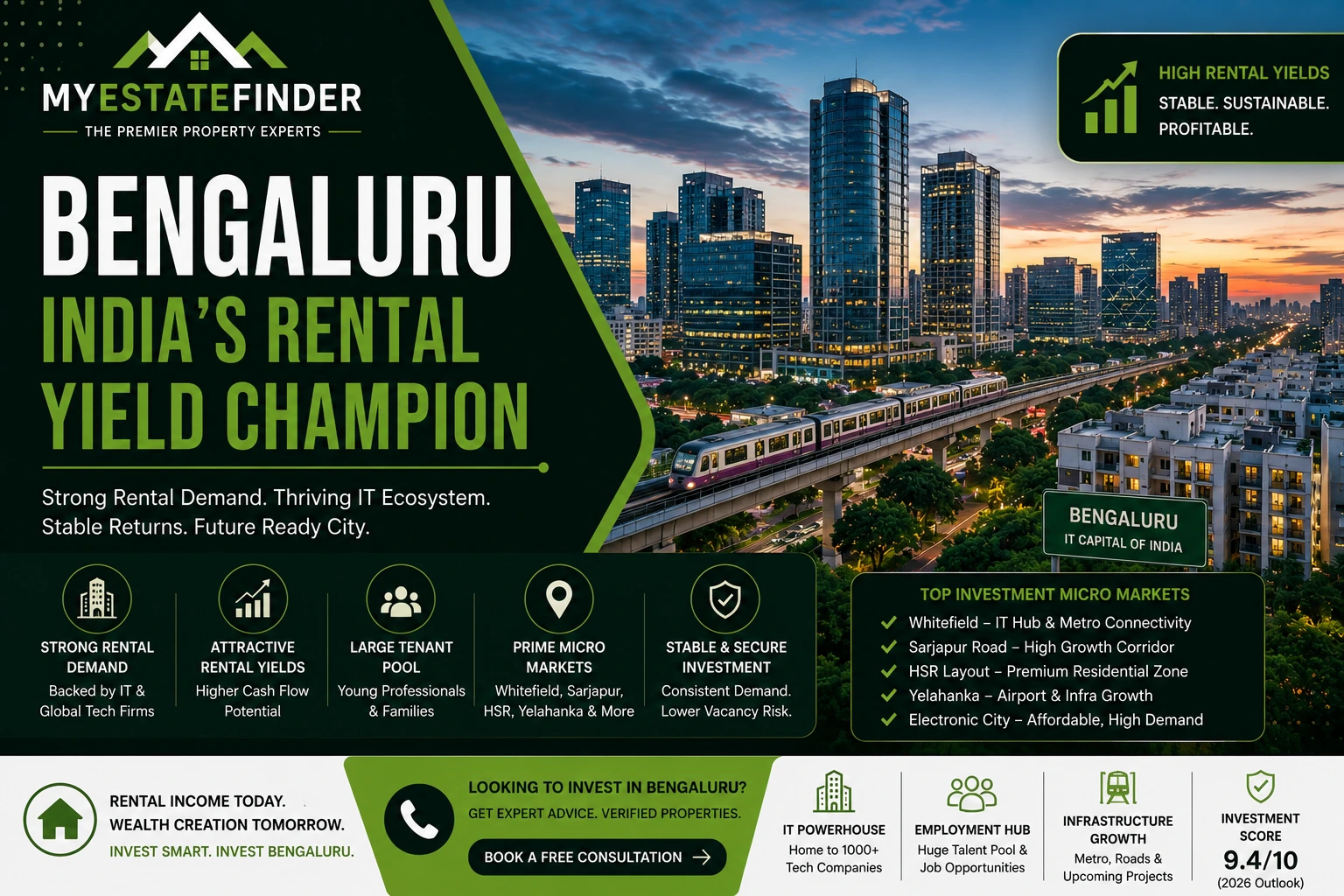
Bengaluru hosts thousands of technology companies.
Major sectors include:
IT Services
Startups
FinTech
E-commerce
Artificial Intelligence
Biotechnology
The city attracts talent from across India, creating sustained housing demand.
Few Indian cities match Bengaluru’s rental absorption capacity.
This supports stronger occupancy rates and stable cash flows.
Major infrastructure projects include:
Namma Metro Expansion
Peripheral Ring Road
Satellite Town Ring Road
Airport Connectivity Projects
| Parameter | Details |
|---|---|
| Investment Rating | 9.4/10 |
| Market Type | Mature Growth Market |
| Appreciation Potential | High |
| Rental Yield Potential | Very High |
| Liquidity | Excellent |
| NRI Appeal | Strong |
| Corporate Demand | Excellent |
| Risk Level | Moderate |
| Location | Average Price/Sq.Ft. | Investment Potential |
|---|---|---|
| Whitefield | ₹10,000–₹16,000 | Very High |
| Sarjapur Road | ₹9,000–₹14,000 | High |
| North Bengaluru | ₹8,500–₹13,500 | Very High |
| Electronic City | ₹6,500–₹10,500 | Moderate to High |
| Hebbal | ₹11,000–₹18,000 | High |
| Devanahalli | ₹7,000–₹11,000 | High |
Major IT employment
Metro connectivity
Strong rental market
Rental investors
Professionals
HNIs
Airport-driven growth
Infrastructure expansion
Commercial activity
Appreciation-focused investors
Long-term buyers
Growing IT corridor
Educational institutions
Family demand
End users
Investors
| Location | Approx. Rental Yield |
|---|---|
| Whitefield | 3.0%–4.0% |
| Hebbal | 2.8%–3.8% |
| Sarjapur Road | 2.8%–3.5% |
| Electronic City | 3.0%–4.2% |
| North Bengaluru | 2.5%–3.5% |
| Corridor | Appreciation Potential |
|---|---|
| North Bengaluru | Very High |
| Whitefield | High |
| Sarjapur Road | High |
| Hebbal | High |
| Devanahalli | High |
One of India’s strongest rental markets.
HNIs
Stable wealth creation opportunities.
Global city with mature real estate dynamics.
Diversification through tangible assets.
Yes. Bengaluru remains one of India’s strongest real estate markets due to exceptional rental demand, technology-led employment growth, and ongoing infrastructure expansion.
Bengaluru combines steady rental income with long-term appreciation potential, making it one of India’s most balanced investment destinations.
Best For:
✓ Rental Investors
✓ HNIs
✓ NRIs
✓ Technology Professionals
✓ Long-Term Investors
Pune has steadily transformed from an education and manufacturing hub into one of India’s most resilient real estate markets. Unlike speculative markets that rely heavily on investor sentiment, Pune’s demand is largely supported by genuine end-users, IT professionals, students, and multinational companies.
For investors seeking a balanced mix of capital appreciation, stable rental income, and lower volatility, Pune deserves a place on the shortlist.
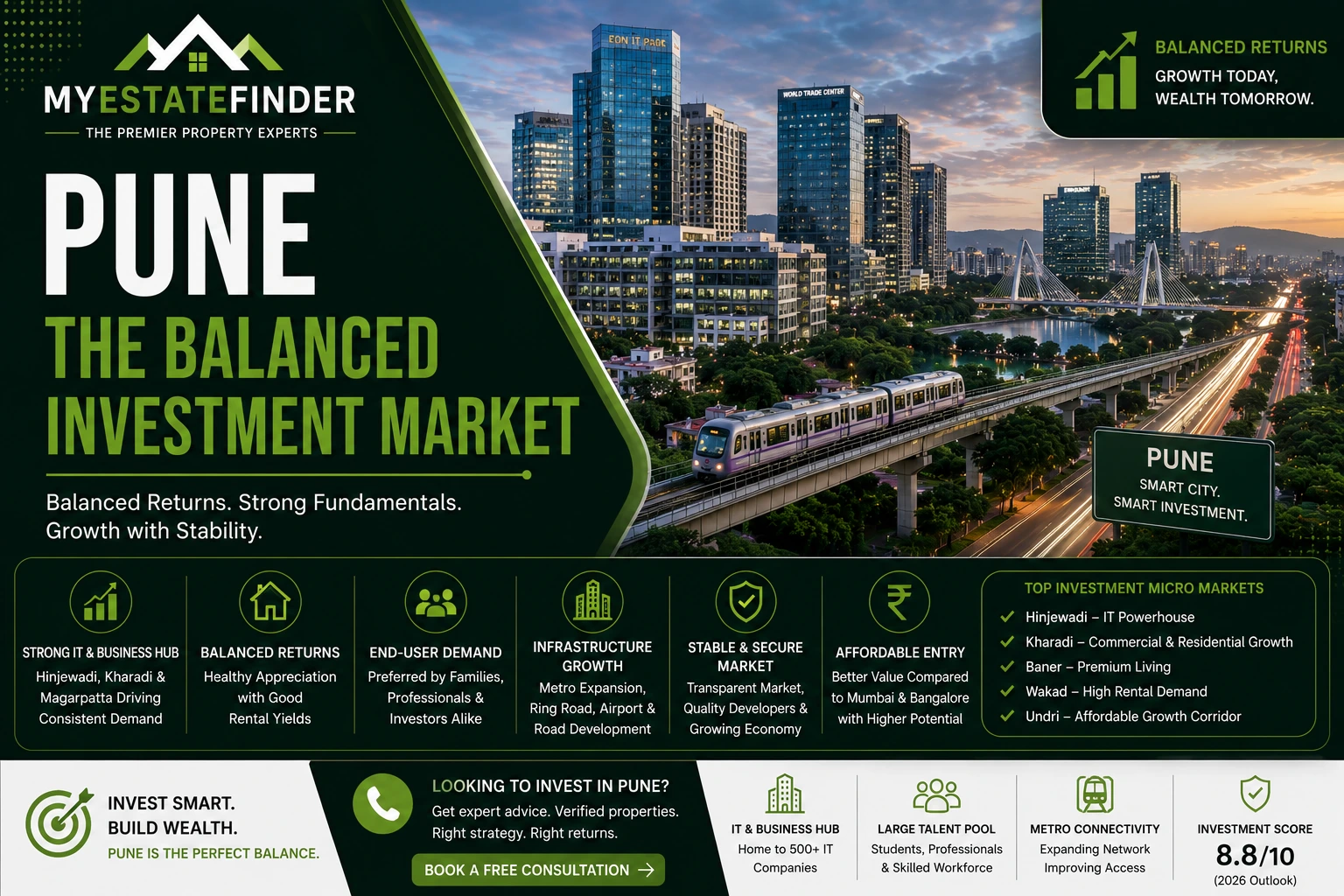
Pune’s economy is supported by multiple industries:
Information Technology
Automobile Manufacturing
Engineering
Education
Financial Services
Startups
Major employment hubs include:
Hinjewadi IT Park
Kharadi
Baner
Wakad
Magarpatta
Pune attracts a continuous influx of:
Students
IT professionals
Entrepreneurs
Manufacturing executives
Families relocating from Mumbai
This creates a strong foundation for both sales and rentals.
Key projects improving Pune’s investment outlook include:
Pune Metro Expansion
Ring Road Projects
Airport Expansion
Improved Highway Connectivity
IT Corridor Expansion
| Parameter | Details |
|---|---|
| Investment Rating | 9.0/10 |
| Market Type | Balanced Growth Market |
| Appreciation Potential | High |
| Rental Yield Potential | High |
| Liquidity | Very Good |
| NRI Appeal | Moderate |
| Corporate Demand | Strong |
| Risk Level | Low to Moderate |
| Location | Average Price/Sq.Ft. | Investment Potential |
|---|---|---|
| Kharadi | ₹10,000–₹16,000 | Very High |
| Hinjewadi | ₹8,000–₹12,500 | High |
| Baner | ₹10,000–₹16,000 | High |
| Wakad | ₹8,000–₹12,000 | Moderate to High |
| Magarpatta | ₹10,500–₹16,500 | High |
| Tathawade | ₹7,500–₹11,000 | Moderate |
Strong corporate presence
Premium residential demand
Excellent connectivity
Rental investors
HNIs
Long-term investors
Massive IT workforce
Affordable entry prices
Strong tenant demand
First-time investors
Rental investors
Premium neighbourhood
Lifestyle appeal
Stable appreciation
Families
End-users
Premium buyers
| Location | Approx. Rental Yield |
|---|---|
| Kharadi | 3.0%–4.0% |
| Hinjewadi | 3.5%–4.5% |
| Baner | 2.8%–3.8% |
| Wakad | 3.0%–4.0% |
| Magarpatta | 3.0%–4.0% |
| Corridor | Appreciation Potential |
|---|---|
| Kharadi | High |
| Baner | High |
| Hinjewadi | High |
| Magarpatta | Moderate to High |
| Wakad | Moderate |
Yes. Pune is one of India’s most balanced real estate markets, offering a combination of stable rental yields, strong employment-driven demand, and consistent appreciation.
Best For:
✓ Rental Investors
✓ Salaried Professionals
✓ Family Offices
✓ Long-Term Investors
✓ First-Time Investors
Noida has emerged as one of India’s most exciting real estate markets. Improved infrastructure, expanding commercial activity, and significantly lower entry prices compared to Delhi have attracted both institutional and retail investors.
For investors seeking appreciation potential within the National Capital Region, Noida remains difficult to ignore.
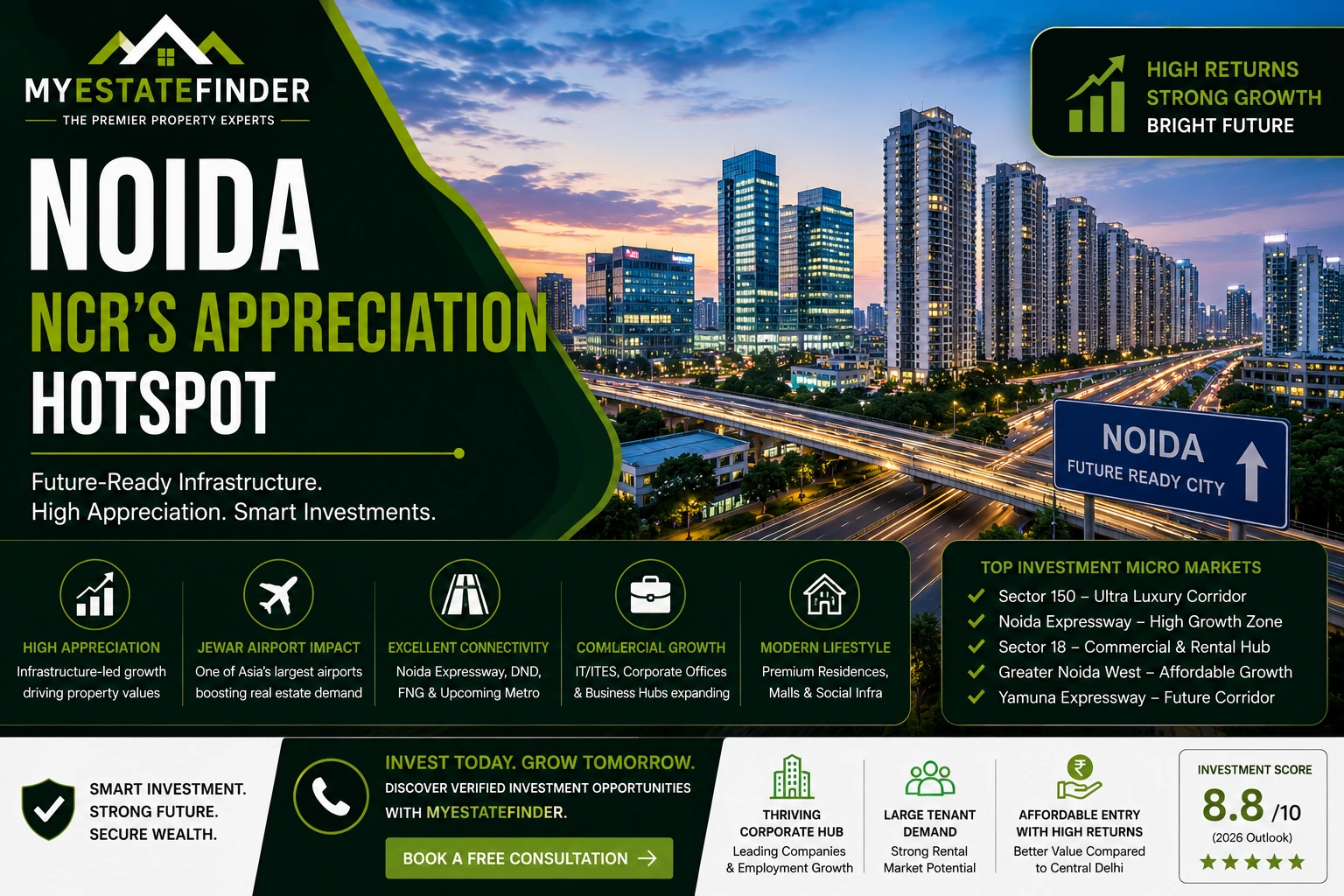
Noida has witnessed transformative infrastructure development.
Major projects include:
Noida International Airport
Jewar Airport Connectivity
Noida-Greater Noida Expressway
Aqua Metro
Film City Development
Investors gain access to premium assets at significantly lower prices than Central Delhi.
This improves affordability and upside potential.
Noida continues attracting:
IT Companies
Startups
Manufacturing Units
Data Centres
Logistics Businesses
| Parameter | Details |
|---|---|
| Investment Rating | 9.2/10 |
| Market Type | Appreciation Market |
| Appreciation Potential | Very High |
| Rental Yield Potential | Moderate |
| Liquidity | Very Good |
| NRI Appeal | Growing |
| Corporate Demand | Strong |
| Risk Level | Moderate |
| Location | Average Price/Sq.Ft. | Investment Potential |
|---|---|---|
| Sector 150 | ₹9,000–₹14,000 | Very High |
| Noida Expressway | ₹9,500–₹15,000 | Very High |
| Sector 79 | ₹8,000–₹12,500 | High |
| Sector 107 | ₹9,500–₹15,000 | High |
| Greater Noida West | ₹6,500–₹10,000 | Moderate to High |
| Yamuna Expressway | ₹6,000–₹9,500 | Very High |
Premium developments
Low-density planning
Lifestyle appeal
HNIs
End-users
Luxury buyers
Corporate connectivity
Premium inventory
Strong appreciation
Investors
Executives
Airport-led growth
Affordable entry
Future upside
Long-term investors
Appreciation seekers
| Location | Approx. Rental Yield |
|---|---|
| Noida Expressway | 2.5%–3.5% |
| Sector 150 | 2.0%–3.0% |
| Sector 107 | 2.5%–3.2% |
| Greater Noida West | 2.8%–3.5% |
| Yamuna Expressway | 2.0%–2.8% |
| Corridor | Appreciation Potential |
|---|---|
| Yamuna Expressway | Very High |
| Sector 150 | Very High |
| Noida Expressway | High |
| Sector 107 | High |
| Greater Noida West | Moderate to High |
Yes. Noida offers strong appreciation potential due to airport-led development, expanding commercial activity, and improving infrastructure, making it one of India’s most attractive investment destinations.
Best For:
✓ Appreciation Investors
✓ NCR Investors
✓ NRIs
✓ Long-Term Investors
✓ Growth-Oriented Buyers
| City | Investment Score | Appreciation Potential | Rental Yield | Best For |
|---|---|---|---|---|
| Gurgaon | 9.5/10 | Very High | Moderate–High | HNIs & NRIs |
| Bengaluru | 9.4/10 | High | Very High | Rental Investors |
| Hyderabad | 9.3/10 | Very High | Moderate–High | Growth Investors |
| Noida | 9.2/10 | Very High | Moderate | NCR Buyers |
| Pune | 9.0/10 | High | High | Balanced Investors |
Focus on:
Gurgaon
Bengaluru
Hyderabad
Consider:
Gurgaon
Hyderabad
Noida
Choose:
Bengaluru
Pune
Hyderabad
Prioritise:
Gurgaon
Noida
Hyderabad
The strongest options are:
Pune
Bengaluru
Gurgaon
India’s real estate market offers multiple avenues for wealth creation. However, the highest returns typically emerge from cities where infrastructure investment, employment generation, and housing demand intersect.
Among the top destinations analysed, Gurgaon remains the strongest premium market, Bengaluru leads in rental demand, Hyderabad offers compelling growth opportunities, Noida benefits from airport-led expansion, and Pune delivers balanced risk-adjusted returns.
The smartest investors do not chase trends—they identify structural growth early, diversify intelligently, and invest in markets supported by strong fundamentals.
Mumbai has always been India’s financial heartbeat. While its high property prices often discourage first-time investors, seasoned investors, HNIs, family offices, and NRIs continue to allocate capital to the Mumbai Metropolitan Region (MMR) because of one simple reason: wealth preservation combined with long-term appreciation.
MMR extends beyond South Mumbai and includes thriving micro-markets such as Thane, Navi Mumbai, Powai, Goregaon, and the upcoming airport-influenced corridors. These locations offer varying entry points while benefiting from the economic strength of India’s largest metropolitan economy.

Unlike many emerging markets, Mumbai’s real estate fundamentals are backed by decades of economic dominance.
Mumbai is home to:
Reserve Bank of India (RBI)
Bombay Stock Exchange (BSE)
National Stock Exchange (NSE)
Major Banks
Financial Institutions
Global Consulting Firms
Media Companies
Conglomerate Headquarters
This concentration of wealth creates sustained housing demand.
MMR attracts:
HNIs
Ultra-HNIs
Family Offices
NRIs
CXOs
Entrepreneurs
Global Executives
This strengthens resale liquidity.
Several mega infrastructure projects are reshaping MMR.
Mumbai Coastal Road
Mumbai Trans Harbour Link (Atal Setu)
Navi Mumbai International Airport
Metro Expansion Network
Goregaon-Mulund Link Road
Versova–Bandra Sea Link
These projects improve accessibility and unlock new investment corridors.
Historically, Mumbai has demonstrated remarkable resilience during economic downturns.
While appreciation may not always be explosive, premium assets in strategic locations often retain value exceptionally well.
| Parameter | Details |
|---|---|
| Investment Rating | 9.4/10 |
| Market Type | Mature Luxury Market |
| Appreciation Potential | High |
| Rental Yield Potential | Moderate to High |
| Liquidity | Excellent |
| NRI Appeal | Excellent |
| Wealth Preservation | Exceptional |
| Corporate Demand | Very Strong |
| Risk Level | Moderate |
Mumbai offers multiple entry points depending on investment objectives.
| Location | Average Price Per Sq.Ft. | Investment Potential |
|---|---|---|
| South Mumbai | ₹45,000–₹90,000+ | High |
| Bandra West | ₹45,000–₹70,000 | High |
| Powai | ₹28,000–₹40,000 | Very High |
| Goregaon | ₹25,000–₹35,000 | High |
| Thane | ₹16,000–₹28,000 | Very High |
| Navi Mumbai | ₹15,000–₹30,000 | Very High |
| Chembur | ₹25,000–₹38,000 | High |
| Mulund | ₹20,000–₹32,000 | High |
Navi Mumbai has evolved from an affordable alternative into one of India’s strongest growth stories.
Navi Mumbai International Airport
Atal Setu Connectivity
Commercial Expansion
Better Urban Planning
Lower Entry Prices
Long-Term Investors
Appreciation Seekers
NRIs
9.5/10
Often referred to as the “Next Mumbai,” Thane continues attracting both end-users and investors.
Relatively Affordable Pricing
Metro Connectivity
Strong Residential Demand
Lifestyle Infrastructure
Family Buyers
Rental Investors
Professionals
9.3/10
Powai remains one of Mumbai’s most prestigious investment destinations.
Premium Lifestyle
Corporate Proximity
Established Demand
Strong Rental Market
HNIs
Executives
Rental Investors
9.4/10
Goregaon benefits from its strategic location between commercial and residential hubs.
Metro Connectivity
Corporate Presence
Entertainment Industry Demand
Lifestyle Amenities
Mid to Premium Investors
Professionals
9.1/10
| Investor Profile | Recommended Area |
|---|---|
| Ultra-HNIs | South Mumbai |
| HNIs | Powai |
| NRIs | Navi Mumbai |
| Rental Investors | Powai, Goregaon |
| Family Buyers | Thane |
| Appreciation Investors | Navi Mumbai |
Despite higher entry prices, Mumbai Metropolitan Region remains one of India’s safest real estate markets for investors seeking wealth preservation, premium rental demand, and long-term appreciation.
The key lies in selecting the right micro-market rather than viewing Mumbai as a single investment destination.
For investors with substantial capital, MMR continues to justify its premium through resilience, liquidity, and enduring demand.
Although Mumbai is often associated with capital appreciation, its rental market remains one of the strongest in India due to sustained demand from professionals, expatriates, and high-income households.
| Location | Approx. Rental Yield | Rental Demand |
|---|---|---|
| South Mumbai | 1.8%–2.5% | High |
| Bandra West | 2.0%–2.8% | Very High |
| Powai | 2.5%–3.5% | Very High |
| Goregaon | 2.5%–3.8% | High |
| Thane | 2.8%–3.8% | High |
| Navi Mumbai | 2.5%–3.5% | Growing |
| Chembur | 2.2%–3.2% | Moderate |
| Mulund | 2.4%–3.3% | Moderate |
Professionals employed by:
Banks
Consulting firms
Media companies
IT companies
Financial institutions
prefer renting near their workplaces.
Prime locations such as Bandra and Powai have constrained supply, helping landlords maintain pricing power.
Global executives working in Mumbai frequently opt for premium rental properties in established neighbourhoods.
While Mumbai may not deliver the explosive growth of emerging markets, it consistently rewards disciplined investors with stable appreciation.
| Location | Five-Year Outlook |
|---|---|
| Navi Mumbai | Very High |
| Thane | High |
| Powai | High |
| Goregaon | Moderate to High |
| Bandra West | Moderate |
| South Mumbai | Moderate |
| Mulund | Moderate to High |
| Chembur | Moderate |
Navi Mumbai currently stands out because of:
Navi Mumbai International Airport
Atal Setu connectivity
Commercial growth
Improved accessibility
Relatively lower entry prices
Different investor profiles require different strategies.
| Investor Type | Recommended Location | Primary Objective |
|---|---|---|
| Ultra-HNIs | South Mumbai | Wealth Preservation |
| HNIs | Powai | Balanced Returns |
| NRIs | Navi Mumbai | Appreciation |
| Family Offices | Bandra West | Asset Diversification |
| Rental Investors | Powai, Goregaon | Cash Flow |
| Family Buyers | Thane | End Use |
| Long-Term Investors | Navi Mumbai | Capital Growth |
Even India’s strongest market carries certain risks.
Prime markets require significant capital allocation.
Ultra-luxury assets often prioritise capital preservation over income generation.
Infrastructure timelines can occasionally shift.
Performance varies substantially across MMR. Choosing the wrong locality can dilute returns.
Yes. Mumbai Metropolitan Region remains one of India’s safest property markets due to strong liquidity, resilient demand, and significant infrastructure investment. Strategic micro-markets such as Navi Mumbai, Powai, and Thane continue offering attractive opportunities for long-term investors.
Navi Mumbai currently offers some of the strongest appreciation potential in MMR due to airport-led development, infrastructure upgrades, and improving connectivity.
Powai and Goregaon remain among the best locations for rental income because of strong corporate demand, premium tenant profiles, and established residential ecosystems.
Mumbai Metropolitan Region continues to justify its position as India’s premier wealth-preservation market.
While investors seeking aggressive appreciation may find stronger opportunities in emerging cities, MMR offers an exceptional balance of:
✓ Excellent Liquidity
✓ Strong Corporate Demand
✓ Premium Rental Market
✓ NRI Appeal
✓ Long-Term Wealth Preservation
✓ Infrastructure-Led Growth
Ultra-HNIs
Family Offices
NRIs
Premium Rental Investors
Wealth Preservation Strategies
The smartest approach to investing in Mumbai is not chasing prestige alone. Investors who focus on high-potential micro-markets such as Navi Mumbai, Powai, and Thane can achieve a stronger combination of appreciation, rental income, and portfolio stability.
For affluent investors building multi-generational wealth, Mumbai Metropolitan Region remains one of India’s most dependable real estate markets.
Chennai may not generate the same headlines as Gurgaon, Bengaluru, or Mumbai, but seasoned investors have long recognised it as one of India’s most resilient real estate markets.
Driven by a diversified economy, robust infrastructure, strong industrial growth, and relatively affordable pricing, Chennai offers investors a unique combination of stability, rental income, and long-term appreciation.
For investors seeking predictable returns rather than speculative gains, Chennai deserves serious consideration.
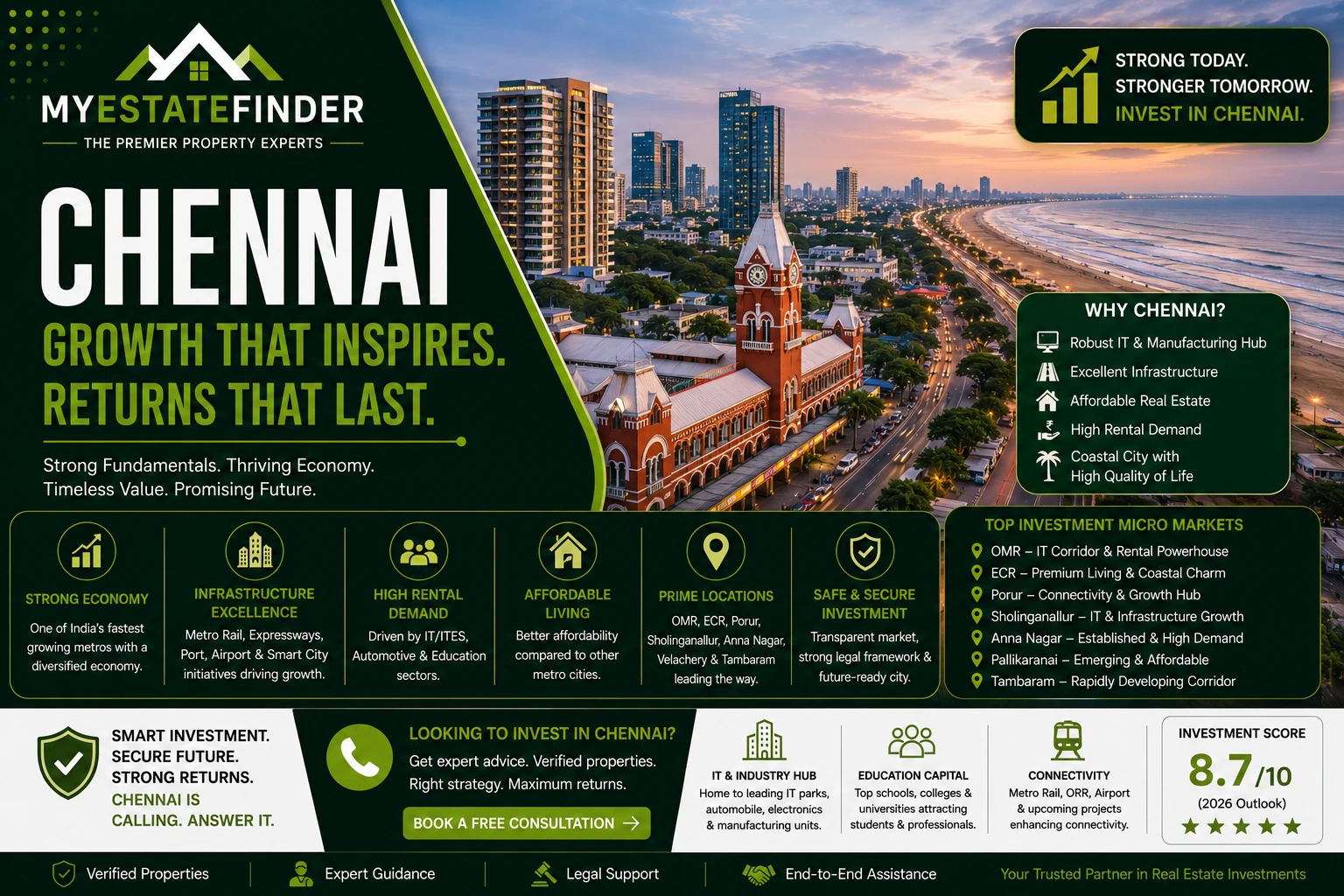
Unlike cities heavily dependent on a single industry, Chennai’s economy is diversified across manufacturing, technology, healthcare, education, and logistics.
Chennai is often referred to as the “Detroit of India.”
Major industries include:
Automobile Manufacturing
Electronics
Aerospace
Healthcare
Information Technology
Logistics
Engineering
Global corporations with a major presence include:
Hyundai
BMW
Renault Nissan
Ford
Caterpillar
Dell
Cognizant
Infosys
TCS
This diversified employment ecosystem supports sustainable housing demand.
Premium housing in Chennai remains significantly more affordable than Mumbai, Gurgaon, and Bengaluru.
This provides investors with:
Better affordability
Lower downside risk
Stronger rental yield opportunities
Improved entry flexibility
Several infrastructure initiatives continue to strengthen Chennai’s investment appeal.
Chennai Metro Phase II
Peripheral Ring Road
Chennai Port-Maduravoyal Corridor
Airport Expansion
IT Corridor Upgrades
Outer Ring Road Connectivity
These developments are improving connectivity and unlocking new residential corridors.
Unlike speculative investment-driven markets, Chennai’s residential demand is heavily supported by end-users.
This creates:
Lower volatility
More stable pricing
Strong occupancy levels
Consistent resale demand
| Parameter | Details |
|---|---|
| Investment Rating | 8.9/10 |
| Market Type | Stable Growth Market |
| Appreciation Potential | Moderate to High |
| Rental Yield Potential | High |
| Liquidity | Very Good |
| NRI Appeal | Moderate |
| Corporate Demand | Strong |
| End-User Demand | Very Strong |
| Risk Level | Low |
| Location | Average Price Per Sq.Ft. | Investment Potential |
|---|---|---|
| OMR (Old Mahabalipuram Road) | ₹8,000–₹13,000 | Very High |
| Velachery | ₹10,000–₹16,000 | High |
| Porur | ₹8,500–₹13,500 | High |
| Pallavaram | ₹7,500–₹11,500 | Moderate to High |
| Anna Nagar | ₹14,000–₹24,000 | High |
| Sholinganallur | ₹8,000–₹12,500 | Very High |
| Perumbakkam | ₹6,500–₹9,500 | Moderate |
| Thoraipakkam | ₹8,500–₹13,000 | High |
OMR remains Chennai’s strongest investment corridor.
Major IT employment hub
Metro expansion benefits
Growing residential ecosystem
Strong rental demand
Rental investors
IT professionals
Long-term investors
9.2/10
One of the fastest-growing residential destinations in Chennai.
IT corridor connectivity
Premium developments
Educational institutions
Competitive pricing
Families
Rental investors
Professionals
9.1/10
Anna Nagar remains one of Chennai’s most prestigious residential addresses.
Established infrastructure
Premium neighbourhood
Strong resale demand
Excellent social amenities
HNIs
End-users
Wealth preservation investors
9.0/10
Porur has emerged as a strong growth corridor.
Metro connectivity
Corporate accessibility
Affordable pricing
Expanding infrastructure
Appreciation investors
Mid-income buyers
8.8/10
Rental income remains one of Chennai’s strongest advantages.
| Location | Approx. Rental Yield | Rental Demand |
|---|---|---|
| OMR | 3.0%–4.2% | Very High |
| Sholinganallur | 3.0%–4.0% | High |
| Velachery | 2.8%–3.8% | High |
| Porur | 2.8%–3.6% | Moderate to High |
| Anna Nagar | 2.5%–3.2% | Moderate |
| Pallavaram | 2.8%–3.5% | Moderate |
Although Chennai has historically delivered moderate appreciation, infrastructure-led growth is creating new opportunities.
| Location | Five-Year Outlook |
|---|---|
| OMR | High |
| Sholinganallur | High |
| Porur | Moderate to High |
| Velachery | Moderate |
| Anna Nagar | Moderate |
| Pallavaram | Moderate |
Different investors benefit from different Chennai micro-markets.
Focus On:
Anna Nagar
Premium OMR Projects
Investment Objective
Wealth Preservation
Focus On:
OMR
Sholinganallur
Velachery
Steady Cash Flow
Focus On:
Porur
OMR
Pallavaram
Appreciation
Focus On:
Anna Nagar
Sholinganallur
Velachery
End Use
Chennai remains relatively stable, but investors should evaluate potential risks.
Cities such as Gurgaon or Hyderabad may deliver faster short-term growth.
Performance differs significantly across localities.
Investors should assess project-level infrastructure planning.
Mid-income pockets occasionally witness temporary supply pressure.
Yes. Chennai is one of India’s most stable real estate markets due to its diversified economy, strong end-user demand, healthy rental yields, and relatively affordable pricing compared to other metros.
OMR (Old Mahabalipuram Road) is widely considered one of Chennai’s best investment corridors because of its IT ecosystem, metro expansion, and strong rental demand.
Yes. Areas such as OMR, Sholinganallur, and Velachery typically offer rental yields ranging between 3% and 4.2%, making Chennai attractive for income-focused investors.
Chennai may not always dominate investment headlines, but it consistently rewards disciplined investors with stability and predictable returns.
Its combination of:
✓ Strong End-User Demand
✓ Diversified Economy
✓ Healthy Rental Yields
✓ Affordable Entry Prices
✓ Infrastructure Expansion
✓ Lower Volatility
makes it one of India’s most underrated investment destinations.
Conservative Investors
Rental Income Seekers
Families
IT Professionals
Long-Term Wealth Builders
For investors who prioritise consistency over speculation, Chennai offers one of the strongest risk-adjusted opportunities in Indian real estate. While it may not generate the fastest appreciation, its resilient fundamentals and stable cash flows make it an essential market to consider within a diversified property portfolio.
Ahmedabad has quietly evolved into one of India’s most promising real estate markets. While it may not command the glamour of Mumbai or Bengaluru, investors are increasingly turning their attention to Ahmedabad because of its strong economic fundamentals, affordable entry prices, pro-business environment, and infrastructure-led growth.
For investors seeking high returns without the pricing pressures of larger metros, Ahmedabad offers compelling opportunities.

Ahmedabad combines industrial strength with improving urban infrastructure and rising residential demand.
Ahmedabad benefits from Gujarat’s reputation as one of India’s most business-friendly states.
Key industries include:
Pharmaceuticals
Textiles
Chemicals
Engineering
Financial Services
Manufacturing
Startups
Major corporate activity supports sustained housing demand.
Compared to other Tier-1 cities, Ahmedabad offers significantly lower acquisition costs.
Benefits include:
Higher affordability
Lower downside risk
Better diversification opportunities
Scope for portfolio expansion
Several infrastructure projects continue enhancing Ahmedabad’s investment appeal.
Ahmedabad Metro Expansion
Sardar Patel Ring Road
GIFT City Connectivity
Bullet Train Corridor
SG Highway Upgrades
Industrial Corridor Development
These initiatives are improving accessibility and unlocking new investment hotspots.
Ahmedabad’s residential market is largely driven by genuine end-user demand rather than speculative activity.
This supports:
Stable pricing
Consistent absorption
Lower volatility
Sustainable growth
| Parameter | Details |
|---|---|
| Investment Rating | 8.8/10 |
| Market Type | Emerging Growth Market |
| Appreciation Potential | High |
| Rental Yield Potential | Moderate |
| Liquidity | Good |
| NRI Appeal | Moderate |
| Corporate Demand | Strong |
| End-User Demand | Very Strong |
| Risk Level | Low to Moderate |
| Location | Average Price Per Sq.Ft. | Investment Potential |
|---|---|---|
| SG Highway | ₹7,500–₹12,500 | Very High |
| GIFT City | ₹8,500–₹14,000 | Very High |
| South Bopal | ₹6,000–₹9,500 | High |
| Shela | ₹6,500–₹10,000 | High |
| Prahlad Nagar | ₹8,000–₹13,000 | High |
| Chandkheda | ₹5,500–₹8,500 | Moderate |
| Vaishnodevi Circle | ₹6,500–₹10,500 | High |
India’s first operational international financial services hub.
Institutional investments
Commercial expansion
Future demand potential
Government support
Long-term investors
Appreciation seekers
NRIs
9.2/10
Ahmedabad’s premium growth corridor.
Corporate accessibility
Lifestyle infrastructure
Strong end-user demand
Premium developments
Families
HNIs
End-users
9.1/10
A rapidly developing residential destination.
Competitive pricing
Improving infrastructure
Family demand
First-time investors
Mid-budget buyers
8.8/10
Emerging as a preferred residential hub.
Future growth potential
Affordable entry
Planned development
Appreciation investors
Long-term buyers
8.9/10
| Location | Approx. Rental Yield | Rental Demand |
|---|---|---|
| GIFT City | 2.5%–3.5% | Growing |
| SG Highway | 2.5%–3.5% | High |
| Prahlad Nagar | 2.8%–3.8% | Strong |
| South Bopal | 2.5%–3.2% | Moderate |
| Shela | 2.2%–3.0% | Moderate |
Ahmedabad’s infrastructure pipeline supports positive long-term prospects.
| Location | Five-Year Outlook |
|---|---|
| GIFT City | Very High |
| SG Highway | High |
| Shela | High |
| South Bopal | Moderate to High |
| Prahlad Nagar | Moderate |
Focus On:
GIFT City
SG Highway
Capital Appreciation
Focus On:
Prahlad Nagar
South Bopal
Stable Growth
Focus On:
GIFT City
SG Highway
Portfolio Diversification
Focus On:
Shela
South Bopal
End Use
Resale timelines may be longer.
Rental demand remains lower than Bengaluru or Gurgaon.
Growth projections depend partly on project completion.
Yes. Ahmedabad is one of India’s most promising emerging real estate markets due to affordable pricing, infrastructure development, and Gujarat’s strong economic growth.
GIFT City currently offers some of Ahmedabad’s strongest appreciation potential because of institutional investment, commercial expansion, and government backing.
Ahmedabad offers lower entry prices and lower volatility than many Tier-1 cities, making it attractive for investors seeking balanced growth rather than aggressive speculation.
Ahmedabad’s strengths lie in affordability, economic stability, and infrastructure-driven growth.
Its combination of:
✓ Affordable Entry Prices
✓ Strong End-User Demand
✓ Gujarat’s Economic Strength
✓ Emerging Commercial Ecosystems
✓ Government-Led Infrastructure
makes it an increasingly attractive destination for investors seeking long-term value.
Conservative Investors
NRIs
Long-Term Investors
Family Buyers
Diversification Strategies
| Factor | Mumbai Metropolitan Region | Chennai | Ahmedabad |
|---|---|---|---|
| Investment Score | 9.4/10 | 8.9/10 | 8.8/10 |
| Entry Cost | Very High | Moderate | Affordable |
| Appreciation Potential | High | Moderate to High | High |
| Rental Yield | Moderate | High | Moderate |
| Liquidity | Excellent | Very Good | Good |
| NRI Appeal | Excellent | Moderate | Moderate |
| Wealth Preservation | Exceptional | Strong | Moderate |
| Risk Level | Moderate | Low | Low to Moderate |
Wealth Preservation
Premium Rental Markets
Excellent Liquidity
Luxury Exposure
Stable Cash Flows
Lower Volatility
End-User Driven Markets
Healthy Rental Income
Affordable Entry Prices
Emerging Growth Opportunities
Long-Term Appreciation
Geographic Diversification
Real estate wealth creation is rarely about chasing the hottest market.
The most successful investors allocate capital across markets that serve different objectives.
Mumbai Metropolitan Region excels at preserving wealth and maintaining liquidity.
Chennai delivers stability and rental consistency.
Ahmedabad offers affordable access to high-growth opportunities.
For HNIs, NRIs, and investors with substantial capital, combining these markets strategically can improve risk-adjusted returns while building a more resilient real estate portfolio.
For decades, Goa was viewed primarily as a holiday destination. Today, it has evolved into one of India’s most attractive lifestyle-driven real estate markets.
The rise of remote work, increasing domestic tourism, premium villa developments, and growing interest from NRIs and HNIs have transformed Goa into a serious investment destination.
Unlike traditional metropolitan markets that rely heavily on employment growth, Goa’s investment appeal is driven by a combination of lifestyle demand, tourism, second-home ownership, and short-term rental opportunities.
For affluent investors looking beyond conventional city investments, Goa offers a compelling opportunity.

Goa delivers a completely different investment proposition compared to Gurgaon, Mumbai, or Bengaluru.
Goa attracts millions of domestic and international visitors annually.
Strong tourist demand supports:
Holiday rentals
Vacation homes
Boutique hospitality investments
Luxury villa rentals
Platforms such as Airbnb and managed vacation rental operators have transformed the economics of second-home ownership.
Many investors now generate substantial rental income during peak seasons.
Affluent buyers increasingly prefer Goa for:
Lifestyle diversification
Retirement planning
Weekend homes
Wealth preservation
Legacy assets
Unlike expanding metropolitan markets, Goa has finite land availability in prime coastal areas.
This scarcity supports long-term pricing strength.
| Parameter | Details |
|---|---|
| Investment Rating | 9.1/10 |
| Market Type | Lifestyle & Rental Market |
| Appreciation Potential | High |
| Rental Yield Potential | Very High |
| Liquidity | Moderate |
| NRI Appeal | Excellent |
| Tourism Demand | Exceptional |
| Wealth Preservation | Strong |
| Risk Level | Moderate |
| Location | Average Price Per Sq.Ft. | Investment Potential |
|---|---|---|
| Assagao | ₹18,000–₹35,000 | Very High |
| Anjuna | ₹15,000–₹30,000 | Very High |
| Vagator | ₹14,000–₹28,000 | High |
| Candolim | ₹16,000–₹32,000 | High |
| Siolim | ₹12,000–₹24,000 | Very High |
| Morjim | ₹12,000–₹22,000 | High |
| Panjim | ₹10,000–₹18,000 | Moderate |
| Dona Paula | ₹14,000–₹26,000 | High |
Often referred to as the “Beverly Hills of Goa,” Assagao has become one of the most premium residential destinations in the state.
Luxury villa developments
Strong HNI demand
Premium lifestyle ecosystem
Limited supply
Ultra-HNIs
NRIs
Second-home buyers
9.5/10
Anjuna combines tourism appeal with strong rental economics.
High tourist footfall
Vibrant social scene
Premium holiday rentals
Strong occupancy levels
Airbnb investors
Rental investors
Lifestyle buyers
9.3/10
Siolim has emerged as one of Goa’s fastest-growing micro-markets.
Relative affordability
Increasing premium developments
Lifestyle appeal
Growing popularity
Appreciation investors
Families
NRIs
9.2/10
Candolim remains one of Goa’s strongest hospitality-driven investment zones.
Tourism demand
Premium hospitality ecosystem
Rental income potential
Established infrastructure
Holiday home investors
Hospitality-focused buyers
9.0/10
One of Goa’s biggest advantages is its ability to generate short-term rental income.
| Location | Long-Term Rental Yield | Short-Term Rental Yield Potential |
|---|---|---|
| Assagao | 2.5%–3.5% | 5%–8% |
| Anjuna | 2.5%–3.8% | 6%–9% |
| Siolim | 2.2%–3.2% | 5%–7% |
| Candolim | 2.5%–3.5% | 6%–8% |
| Vagator | 2.5%–3.5% | 5%–8% |
| Morjim | 2.2%–3.2% | 4.5%–7% |
Goa’s appreciation story is supported by scarcity and lifestyle migration trends.
| Location | Outlook |
|---|---|
| Assagao | Very High |
| Siolim | Very High |
| Anjuna | High |
| Vagator | High |
| Candolim | High |
| Morjim | Moderate to High |
| Panjim | Moderate |
Focus On:
Assagao
Candolim
Luxury Villas
Lifestyle Diversification
Focus On:
Assagao
Siolim
Anjuna
Retirement Planning & Wealth Preservation
Focus On:
Anjuna
Candolim
Vagator
Short-Term Rental Income
Focus On:
Siolim
Dona Paula
Panjim
Second Home Ownership
Goa offers attractive returns, but investors must understand its unique risks.
Tourism demand fluctuates throughout the year.
Short-term rental regulations may evolve over time.
Properties can take longer to sell compared to major metros.
Holiday homes often require professional management.
Yes. Goa is one of India’s most attractive lifestyle investment destinations due to strong holiday rental demand, increasing HNI participation, and limited premium inventory.
Assagao is widely regarded as Goa’s most premium investment destination, while Anjuna and Siolim offer an excellent balance between appreciation potential and rental income.
Yes. Investors can generate income through both long-term rentals and short-term holiday rentals. In prime tourist locations, short-term rental yields may significantly exceed traditional residential yields.
Goa is no longer just a vacation destination.
It has evolved into a sophisticated lifestyle asset class capable of delivering:
✓ High Short-Term Rental Income
✓ Premium Lifestyle Value
✓ Strong NRI Appeal
✓ Limited Supply Advantage
✓ Long-Term Appreciation Potential
✓ Portfolio Diversification Benefits
HNIs
NRIs
Holiday Home Investors
Airbnb Investors
Retirement Buyers
Lifestyle Investors
For affluent investors seeking diversification beyond traditional metropolitan markets, Goa offers a unique combination of emotional value and financial returns.
While it may not replace core investments in cities such as Gurgaon or Mumbai, it can serve as a powerful complementary asset within a well-diversified real estate portfolio.
Navi Mumbai has moved far beyond its original identity as an affordable extension of Mumbai. Today, it is one of India’s most compelling real estate investment destinations, driven by transformational infrastructure, planned urban development, and increasing corporate interest.
For investors seeking a combination of capital appreciation, improving rental demand, and lower entry costs than Mumbai city, Navi Mumbai presents a compelling opportunity.
The upcoming operationalisation of the Navi Mumbai International Airport, combined with connectivity upgrades and commercial expansion, has positioned the region as one of India’s strongest long-term investment bets.
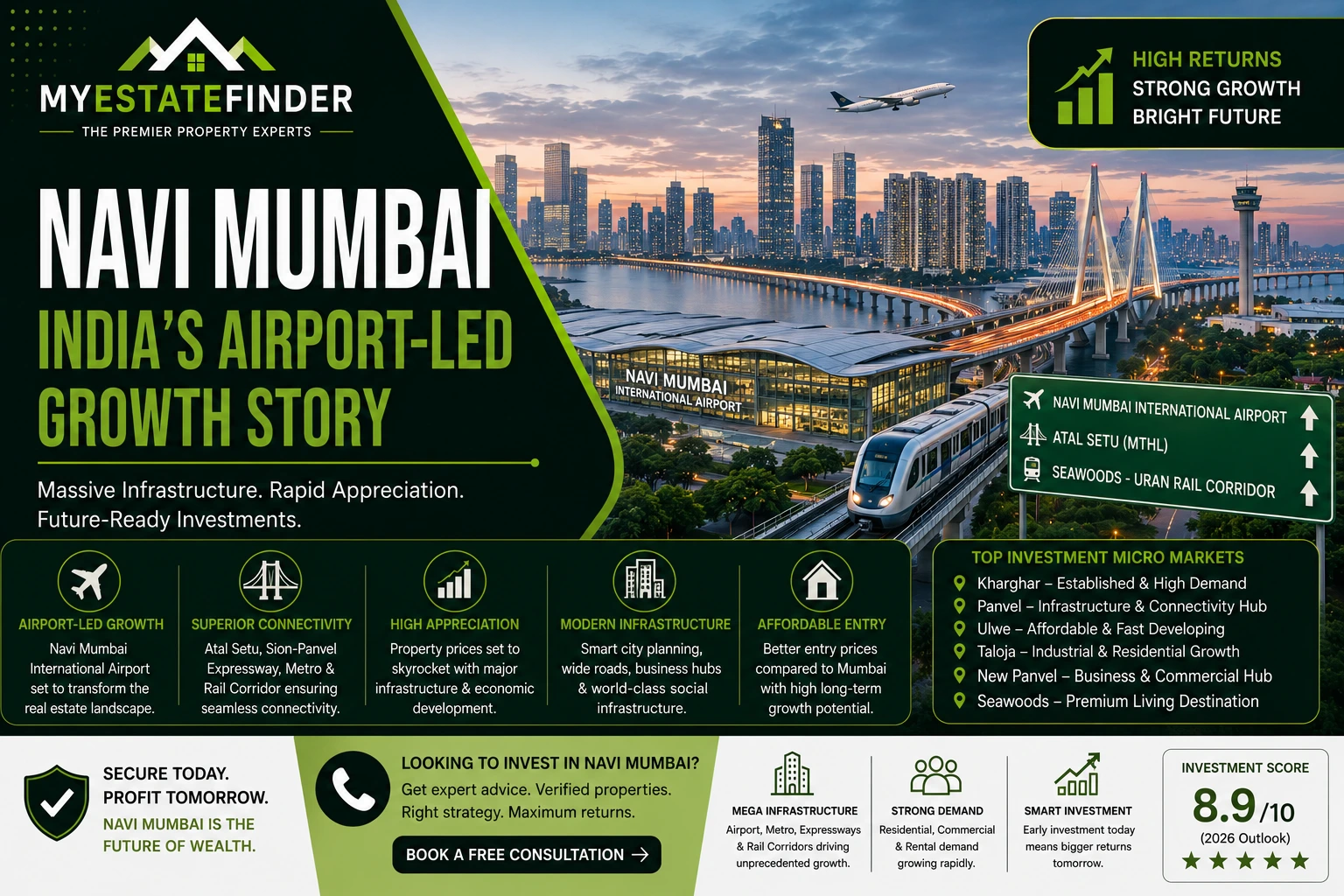
Unlike saturated metropolitan cores, Navi Mumbai offers investors access to a growth market backed by strong infrastructure fundamentals.
The Navi Mumbai International Airport is expected to redefine the region’s economic landscape.
Increased employment generation
Enhanced global connectivity
Commercial development
Improved investor confidence
Higher residential demand
Airport-led development has historically transformed real estate markets worldwide.
Navi Mumbai was designed with long-term growth in mind.
Advantages include:
Wider roads
Better zoning
Lower congestion
Organised infrastructure
Large green spaces
Compared to older metropolitan centres, Navi Mumbai offers superior urban planning.
Major infrastructure projects continue to improve accessibility.
Navi Mumbai International Airport
Atal Setu (Mumbai Trans Harbour Link)
Mumbai Suburban Rail Network
Metro Expansion
Coastal Connectivity Projects
Expressway Enhancements
These projects strengthen Navi Mumbai’s integration with the larger MMR ecosystem.
Compared to prime Mumbai markets, Navi Mumbai offers significantly lower acquisition costs.
Benefits include:
Higher affordability
Better appreciation potential
Portfolio diversification
Lower capital barriers
| Parameter | Details |
|---|---|
| Investment Rating | 9.4/10 |
| Market Type | Infrastructure-Led Growth Market |
| Appreciation Potential | Very High |
| Rental Yield Potential | Moderate to High |
| Liquidity | Very Good |
| NRI Appeal | Strong |
| Wealth Preservation | Strong |
| Corporate Demand | Growing |
| Risk Level | Moderate |
| Location | Average Price Per Sq.Ft. | Investment Potential |
|---|---|---|
| Ulwe | ₹12,000–₹20,000 | Very High |
| Kharghar | ₹13,000–₹22,000 | Very High |
| Panvel | ₹9,000–₹15,000 | High |
| Nerul | ₹16,000–₹28,000 | High |
| Seawoods | ₹18,000–₹30,000 | High |
| Taloja | ₹7,000–₹11,000 | Moderate to High |
| Airoli | ₹15,000–₹24,000 | High |
| Ghansoli | ₹14,000–₹23,000 | High |
Ulwe has emerged as Navi Mumbai’s most discussed investment destination.
Proximity to the airport
Atal Setu accessibility
Strong appreciation potential
Growing residential demand
Long-term investors
Appreciation seekers
NRIs
9.6/10
Kharghar combines established infrastructure with future growth.
Educational institutions
Commercial activity
Lifestyle amenities
Strong end-user demand
Families
Professionals
Balanced investors
9.4/10
Panvel continues to attract investors due to its affordability and infrastructure pipeline.
Airport influence
Lower entry prices
Future commercial expansion
Connectivity upgrades
First-time investors
Long-term buyers
Appreciation-focused investors
9.2/10
One of Navi Mumbai’s premium residential destinations.
Established ecosystem
Premium developments
Excellent connectivity
Strong tenant demand
HNIs
End-users
Rental investors
9.3/10
Rental demand continues improving as employment opportunities expand.
| Location | Approx. Rental Yield | Rental Demand |
|---|---|---|
| Kharghar | 2.8%–3.8% | High |
| Ulwe | 2.5%–3.5% | Growing |
| Panvel | 2.5%–3.2% | Moderate |
| Seawoods | 2.8%–3.8% | High |
| Airoli | 3.0%–4.0% | Very High |
| Ghansoli | 3.0%–4.2% | Very High |
| Nerul | 2.8%–3.5% | High |
Navi Mumbai’s growth story is fundamentally linked to infrastructure execution.
| Location | Five-Year Outlook |
|---|---|
| Ulwe | Very High |
| Panvel | Very High |
| Kharghar | High |
| Airoli | High |
| Ghansoli | High |
| Seawoods | Moderate to High |
| Nerul | Moderate |
Different micro-markets cater to different investor objectives.
Focus On:
Ulwe
Panvel
Kharghar
Capital Growth
Focus On:
Airoli
Ghansoli
Seawoods
Steady Income
Focus On:
Ulwe
Kharghar
Seawoods
Portfolio Diversification
Focus On:
Kharghar
Nerul
Seawoods
End Use
Navi Mumbai’s outlook remains strong, but investors should account for the following factors.
Appreciation assumptions often depend on project completion schedules.
Returns vary significantly between established and emerging nodes.
Certain pockets may experience temporary inventory pressure.
Airport-led markets require medium to long-term holding periods.
Yes. Navi Mumbai is one of India’s most attractive investment destinations due to airport-led development, planned infrastructure, improving connectivity, and comparatively affordable entry prices.
Ulwe currently offers some of the strongest appreciation potential because of its strategic location near Navi Mumbai International Airport and major connectivity projects.
For investors prioritising appreciation and affordability, Navi Mumbai often provides stronger upside potential. Mumbai, however, remains superior for wealth preservation and liquidity.
Navi Mumbai represents one of India’s most compelling infrastructure-led real estate stories.
Its strengths include:
✓ Airport-Led Appreciation Potential
✓ Better Urban Planning
✓ Lower Entry Costs
✓ Strong NRI Appeal
✓ Improving Rental Demand
✓ Long-Term Growth Prospects
Appreciation Investors
NRIs
Family Buyers
Long-Term Investors
Balanced Portfolios
For investors seeking the next phase of Mumbai’s growth story without paying South Mumbai premiums, Navi Mumbai offers one of the strongest opportunities available today.
While patience is essential, disciplined investors who select the right micro-markets can benefit from a powerful combination of infrastructure-driven appreciation, improving rental economics, and long-term wealth creation.
After analysing India’s most promising investment destinations, one conclusion becomes clear:
There is no single “best” city for every investor.
The right destination depends on your investment objective, holding period, risk appetite, capital availability, and desired balance between appreciation and rental income.
This section helps affluent investors identify exactly where their money should go.
| Rank | City | Investment Score | Appreciation Potential | Rental Yield Potential | Entry Cost | Best For |
|---|---|---|---|---|---|---|
| 1 | Gurgaon | 9.5/10 | Very High | Moderate–High | High | HNIs & NRIs |
| 2 | Bengaluru | 9.4/10 | High | Very High | Moderate–High | Rental Investors |
| 3 | Mumbai Metropolitan Region | 9.4/10 | High | Moderate–High | Very High | Wealth Preservation |
| 4 | Navi Mumbai | 9.4/10 | Very High | Moderate | Moderate | Appreciation Investors |
| 5 | Hyderabad | 9.3/10 | Very High | Moderate–High | Moderate | Growth Investors |
| 6 | Noida | 9.2/10 | Very High | Moderate | Moderate | NCR Investors |
| 7 | Goa | 9.1/10 | High | Very High | Moderate–High | Lifestyle Investors |
| 8 | Pune | 9.0/10 | High | High | Moderate | Balanced Investors |
| 9 | Chennai | 8.9/10 | Moderate–High | High | Moderate | Conservative Investors |
| 10 | Ahmedabad | 8.8/10 | High | Moderate | Affordable | Diversification Investors |
Different cities offer different combinations of risk and reward.
| City | Return Potential | Risk Level | Suggested Holding Period |
|---|---|---|---|
| Gurgaon | Very High | Moderate | 5–10 Years |
| Bengaluru | High | Low–Moderate | 5–8 Years |
| MMR | High | Moderate | 7–10 Years |
| Navi Mumbai | Very High | Moderate | 5–8 Years |
| Hyderabad | Very High | Moderate | 5–8 Years |
| Noida | Very High | Moderate–High | 5–8 Years |
| Goa | High | Moderate | 5–10 Years |
| Pune | High | Low | 5–7 Years |
| Chennai | Moderate–High | Low | 5–7 Years |
| Ahmedabad | High | Low–Moderate | 6–10 Years |
Focus on emerging growth corridors where entry barriers remain reasonable.
Ahmedabad
Noida
Navi Mumbai (Panvel/Taloja)
Pune (Hinjewadi/Wakad)
These markets provide:
✓ Lower acquisition costs
✓ Strong future upside
✓ Better portfolio diversification
This budget allows access to established premium micro-markets.
Hyderabad
Noida
Pune
Bengaluru
Navi Mumbai
Investors can balance:
✓ Appreciation
✓ Rental income
✓ Lower volatility
This category represents affluent professionals and successful entrepreneurs.
Gurgaon
Bengaluru
Hyderabad
Goa
Mumbai Suburbs
Investors gain access to premium residential assets capable of delivering stronger wealth creation.
This segment can target luxury and ultra-luxury opportunities.
Gurgaon
Mumbai
Goa
Bengaluru
These markets provide:
✓ Wealth preservation
✓ Strong demand
✓ Prestige value
✓ Institutional appeal
Ultra-HNIs should focus on long-term strategic allocation.
South Mumbai
Gurgaon Luxury Corridors
Goa Luxury Villas
Powai
Bandra West
These locations offer:
✓ Scarcity-driven appreciation
✓ Exceptional liquidity
✓ Legacy asset creation
| City | Allocation Focus |
|---|---|
| Gurgaon | Luxury Appreciation |
| Mumbai | Wealth Preservation |
| Goa | Lifestyle Diversification |
| Bengaluru | Rental Stability |
Blend premium assets with income-generating investments.
| City | Investment Objective |
|---|---|
| Gurgaon | Capital Growth |
| Hyderabad | Growth Potential |
| Navi Mumbai | Infrastructure Story |
| Goa | Retirement Planning |
Prioritise professionally managed assets with strong resale potential.
Bengaluru
Pune
Hyderabad
Chennai
Powai (MMR)
Tenant demand
Corporate hubs
Occupancy stability
Gurgaon
Navi Mumbai
Hyderabad
Noida
Goa
Infrastructure catalysts
Limited premium supply
Early-stage corridors
Chennai
Pune
Mumbai
Ahmedabad
Stability
End-user demand
Lower volatility
Many affluent investors concentrate too much capital in one city.
A diversified approach often delivers superior risk-adjusted returns.
| Allocation | Suggested City | Objective |
|---|---|---|
| ₹3 Crore | Gurgaon | Appreciation |
| ₹2.5 Crore | Bengaluru | Rental Income |
| ₹2 Crore | Navi Mumbai | Growth |
| ₹1.5 Crore | Goa | Lifestyle |
| ₹1 Crore | Ahmedabad | Diversification |
Before buying property in any city, ask:
Employment, tourism, infrastructure, or end-users?
Avoid overpaying during peak cycles.
Understand resale liquidity.
Short-term expectations often lead to disappointment.
Every investment should have a defined role.
Gurgaon currently ranks among India’s strongest investment destinations due to premium housing demand, corporate expansion, and infrastructure growth. However, the ideal city depends on whether an investor prioritises appreciation, rental income, wealth preservation, or lifestyle diversification.
Bengaluru remains one of India’s strongest rental markets due to sustained demand from technology professionals, startups, and multinational corporations.
Gurgaon, Navi Mumbai, Hyderabad, and Noida currently offer some of India’s strongest appreciation opportunities because of infrastructure-led growth and expanding employment ecosystems.
India’s real estate market is no longer a single-story opportunity.
Each city serves a different purpose:
Gurgaon rewards investors seeking luxury appreciation.
Bengaluru excels in rental performance.
Mumbai protects wealth.
Navi Mumbai benefits from transformational infrastructure.
Hyderabad combines affordability with growth.
Noida captures airport-led expansion.
Goa offers lifestyle diversification.
Pune provides balanced returns.
Chennai delivers stability.
Ahmedabad creates affordable entry into high-growth opportunities.
The wealthiest investors rarely chase trends. They build portfolios aligned with objectives, diversify intelligently, and allow quality assets time to compound.
If the goal is maximum appreciation, Gurgaon, Navi Mumbai, Hyderabad, and Noida deserve priority consideration.
If the objective is steady rental income, Bengaluru, Pune, and Chennai stand out.
If the focus is wealth preservation and legacy asset creation, Mumbai remains unmatched.
For investors seeking lifestyle value alongside financial returns, Goa offers a unique proposition.
The best places to invest in India for high returns are those where infrastructure, employment, demand, and disciplined capital allocation intersect.
Choosing the right city is only half the equation. The other half is selecting an investment that aligns with your financial objectives.
Before investing, answer these five questions.
Different investors have different objectives.
| Investment Goal | Best Cities |
|---|---|
| Capital Appreciation | Gurgaon, Noida, Navi Mumbai |
| Rental Income | Bengaluru, Pune, Chennai |
| Wealth Preservation | Mumbai |
| Lifestyle + Returns | Goa |
| Balanced Growth | Hyderabad |
Expert Insight: Investors often make the mistake of chasing markets that don’t match their goals. A rental-focused investor should not buy purely for appreciation, and vice versa.
| Holding Period | Recommended Markets |
|---|---|
| 3–5 Years | Noida, Hyderabad |
| 5–8 Years | Gurgaon, Navi Mumbai, Bengaluru |
| 8–10 Years | Mumbai, Goa, Ahmedabad |
Longer holding periods generally reduce volatility and improve the compounding effect of appreciation.
| Risk Appetite | Suggested Cities |
|---|---|
| Low | Chennai, Pune, Mumbai |
| Moderate | Bengaluru, Hyderabad, Ahmedabad |
| High | Gurgaon, Noida, Navi Mumbai, Goa |
Focus on:
Focus on:
Markets with stronger resale demand provide easier exits.
Even experienced investors occasionally make poor decisions.
Avoid these common mistakes.
Rapid appreciation attracts attention.
However, buying solely because a market has performed well recently can lead to poor outcomes.
Focus on fundamentals.
Not every announced project gets completed on schedule.
Verify:
A great location cannot compensate for a poor developer.
Always evaluate:
Putting all your capital into one city increases portfolio risk.
Diversification improves resilience.
Consider:
Many affluent investors compare property with traditional asset classes.
| Asset Class | Return Potential | Risk | Income Generation | Inflation Hedge |
|---|---|---|---|---|
| Real Estate | High | Moderate | Yes | Strong |
| Equity | Very High | High | Limited | |
| Gold | Moderate | Low | No | |
| Fixed Deposits | Low | Low | Yes | |
| Bonds | Moderate | Low | Yes | |
| REITs | Moderate | Moderate | Yes |
Real estate offers:
India’s property market is entering a new phase.
Several structural trends are expected to shape returns over the next five years.
Demand for larger, higher-quality homes continues to rise.
Expressways, airports, and metro networks increasingly determine returns.
Indian expatriates remain one of the strongest sources of premium housing demand.
Select Tier-2 cities could emerge as future investment hotspots.
Professionally managed rental assets are becoming increasingly popular.
| Objective | Best Choice |
|---|---|
| Maximum Appreciation | Gurgaon |
| Rental Income | Bengaluru |
| Wealth Preservation | Mumbai |
| Growth Potential | Hyderabad |
| Airport-Led Growth | Navi Mumbai |
| NCR Opportunity | Noida |
| Lifestyle Investment | Goa |
| Balanced Returns | Pune |
| Stability | Chennai |
| Affordable Growth | Ahmedabad |
The best place to invest in India for high returns is not necessarily the city generating the loudest headlines.
Successful investors focus on fundamentals, align investments with long-term objectives, diversify intelligently, and remain patient through market cycles.
Those principles have consistently outperformed speculation.
 419-424, 4th Floor, JMD Megapolis, Sohna Road, Gurgaon-122018
 +91 7064545451
 info@myestatefinder.com